
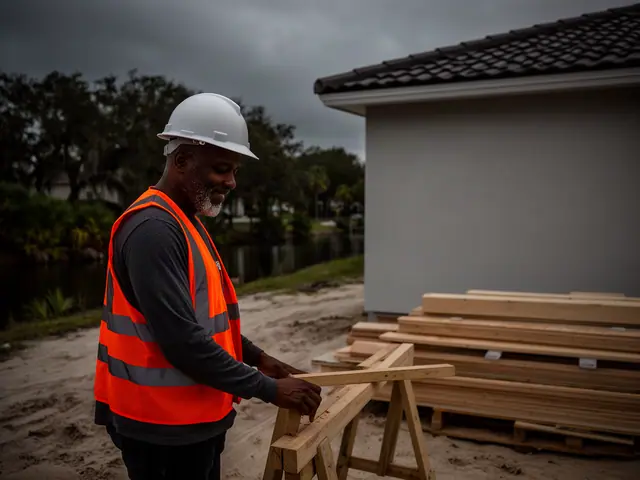
Elmpark Capital Group places contractor business loan requests from Palm Coast, Florida owners with funding partners, who decide on them. Flagler County, FL counted 420 construction employer establishments in 2023 (County Business Patterns). This page covers equipment, working capital between draws, retainage and change orders, credit lines and records.
At a glance
- Construction employer establishments, county
420, the most of any sector (CBP 2023)
- Construction firms under five employees
73.1% (CBP 2023)
- New housing units permitted, county
2,586 in 2025 (Building Permits Survey)
Financing for Contractors: Remodelers and Finish Crews in Palm Coast, FL
Construction in Flagler County, FL is a sector of small crews. County Business Patterns counted 420 construction employer establishments in 2023 with 2,011 paid employees and $91.5 million in annual payroll, and 73.1% had fewer than five employees. Residential building construction counted 106, 67 of them residential remodelers; building finishing contractors counted 109; building equipment contractors (plumbing, electrical, HVAC) 74; foundation and exterior contractors 59.
Housing permits explain much of the work. The Building Permits Survey counted 2,529 new housing units authorized in the county in 2023, 2,588 in 2024 and 2,586 in 2025, and each of those houses passes through framers, roofers, finishers and mechanical trades before it closes.
Construction Equipment Financing: Skid Steers, Trailers and Work Trucks
Skid steers, compact excavators, trenchers, work trucks, dump trailers, scaffolding and paint rigs are financed with the machine as collateral. Used machines are common; partners ask for hours, year and condition. Equipment financing in Palm Coast, FL covers loans versus leases.
Illustration only, invented figures: a site crew buys a $64,000 used compact track loader with $6,400 down and finances the rest over 60 months at an invented annual rate of 9.5%; the payment is about $1,210 a month (our arithmetic).
Contractor Working Capital: The Formula Behind the Gap
A contractor’s working capital need is the cost carried between starting a job and being paid for it. A workable formula: weekly crew and materials cost, times the weeks from start to payment, minus any deposit received. Add retainage held back until the job closes.
Illustration only, invented figures: a tile and flooring crew runs $6,500 a week in wages and materials on a six-week job, receives a $8,000 deposit, and is paid the balance 30 days after completion. Over the invented ten weeks from start to payment, the crew carries about $31,000 of cost (our arithmetic: 6,500 times 6, minus 8,000).
Line of Credit for Construction Crews Doing Site Work
Excavation and site crews buy fuel, parts and aggregate in irregular amounts and are paid on progress draws. A business line of credit lets the crew draw for each job and pay the line down when the draw arrives, without taking a new loan for every contract.
Business Loans for Builders Taking On Larger Jobs in Flagler County, FL
A crew moving from small remodels to larger contracts faces bigger material orders, more crew and longer waits for payment. Partners read the contract, the payment schedule, the general contractor’s payment history if known, and the crew’s own track record of finished jobs. A larger working capital request backed by a signed contract reads very differently from one without.
Working Capital for a Construction Company Between Draws
Draws arrive after inspections and paperwork, often weeks after the work they pay for. Working capital sized to the gap between payroll and the next draw keeps a crew working. Match the term to the job: a loan that outlasts the contract keeps costing after the money has come in.
Cash Flow Issues in Construction: Retainage, Change Orders and Slow Pay
- Retainage: a share of each payment held back until completion, often several percent of the contract.
- Change orders: extra work done before the paperwork is signed and billed.
- Slow pay: general contractors that pay subcontractors only after they are paid.
- Material price changes between bid and purchase.
Illustration only, invented figures: on an invented $120,000 subcontract with 10% retainage, $12,000 is held until the job closes (our arithmetic). That held amount is part of the gap a credit line or working capital loan may need to cover.
Trucks and Trailers for a Growing Flagler County, FL Crew
A second crew needs a second truck, a trailer and a set of tools before it bills its first job. Vehicles are financed like other equipment, with the title as collateral. Partners read whether the existing workload supports the extra payment, so a backlog of signed work strengthens the request.
Builders by ZIP: Construction Counts for ZIP 32137, ZIP 32110 and No-Payroll Firms
ZIP 32137 counted 158 construction employer establishments in 2023 and ZIP 32110, around Bunnell, FL, 91 (ZBP 2023). Nonemployer Statistics counted 1,479 construction businesses without paid employees in the county for 2024, a separate program. The Bunnell, FL page looks at that ZIP’s construction mix.
Contracts, Draw Schedules and Equipment Quotes: The Contractor File
- Recent bank statements for the business and its last tax return.
- Signed contracts and their payment or draw schedules.
- An accounts receivable list with dates.
- Equipment quotes, with hours and year for used machines.
- Your Florida contractor license number where the trade requires one.
Landscaping equipment financing covers grounds crews, and lease or finance business equipment works through the lease decision. The Palm Coast, FL page has local permit links.
By Elmpark Capital Group · Updated